Showing posts with label "The A-Z of Art: The World's Greatest and Most Popular Artists and Their Works". Show all posts

Thursday, January 20, 2011

Fra Angelico

Noli Me Tangere
1425-30
Fresco
180 x 146 cm
Cell 1, Convent of San Marco, Florence


"Fra Angelico was a Dominican friar in the monastery at Fiesole. The convent of San Marco was taken over by his Order in 1436, and he was commissioned to decorate the friar's cells with frescoes painted directly on to wet plaster walls. These were intended to stimulate prayer and meditation rather than to be a factual record of the Biblical story. He wanted to represent the sacredness of Christ in all its glory and simplicity; although he understood the principles of perspective, as seen here in the rendition of the tomb door, these were often sacrificed for a simple style. In the nineteenth century Angelico's painting captured the imagination of the Pre-Raphaelites, who saw in them the charm of a pure faith. In this fresco, Christ appears to Mary Magdalene. She has been weeping after discovering that his tomb is empty. A figure appears. At first she mistakes him for a gardener as he is carrying a hoe. Suddenly realizing who it is, she goes to embrace him. But he moves away, telling her not to touch him - literally 'Noli Me Tangere'."

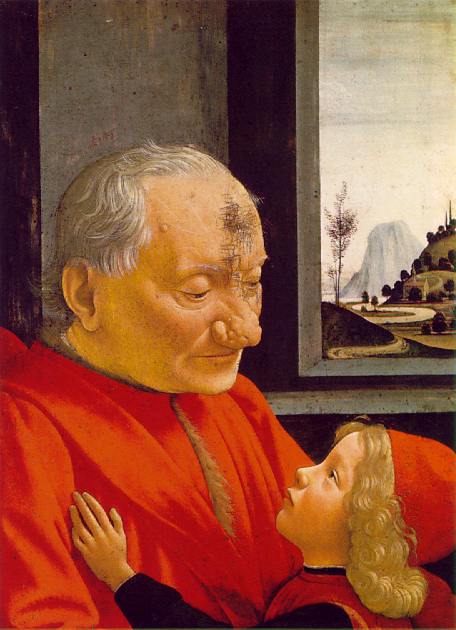
Domenico Ghirlandaio

Portrait of an Old man with a Young Boy
Wood
25 x 18 in. (63 x 46 cm)
Musée du Louvre, Paris


Domenico Ghirlandaio trained as a goldsmith. In 1490, the Duke of Milan received a report that described a handful of good artists available for work in one region. Of Domenico Ghirlandaio it was suggested that he was a notable painter of panels and a master of fresco. It went on to commend his work and to describe him as an efficient and prolific artist. Ghirlandaio employed hordes of assistants - one of whom was Michelangelo - in his prosperous, family-run business. Ghirlandaio is best known for his frescoes, in which he often set religious subjects in a secular setting and in which he included recognizable portraits. His largest commission, completed in 1490, depicting scenes from the lives of the Virgin and St John the Baptist, was in the Santa Maria Novella, Florence. Ironically, in An Old Man and his Grandson, one of his best works, the identity of the protagonists remains a mystery. This naturalistic double portrait is an intimate and moving portrayal of a tender relationship between doting age and attendant youth. The loving young boy is oblivious to the old man's unfortunate physiognomy, a symptom of rhinophyma, from which he suffered.